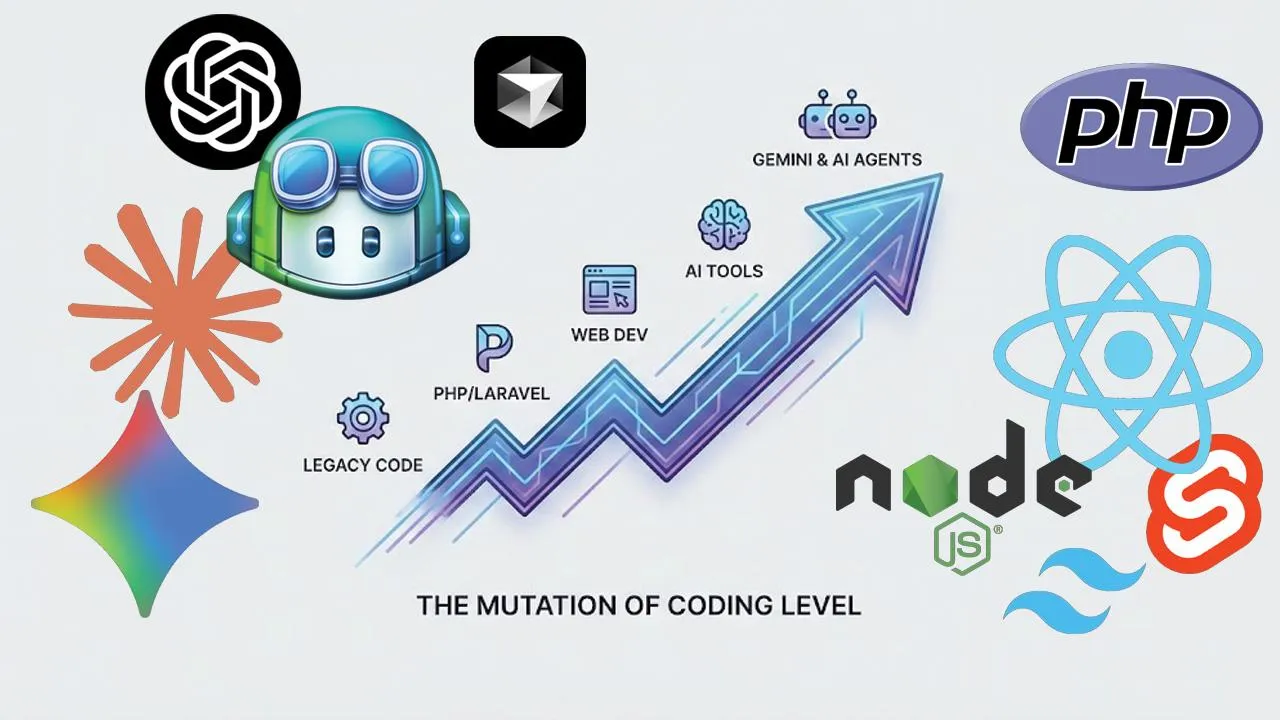
Technology never dies. It bends, it bruises, it gets infected by viruses or attacked by hackers, but it never stops breathing. It only mutates, evolves, and rises stronger just like every living organism.
Go back two centuries. Charles Babbage dreamed of an Analytical Engine, a mechanical calculator made of brass gears and punch cards. That machine never fully worked in his lifetime, yet it carried the seed of everything we touch today. From that clunky “commonly operated machine particularly used for technical and educational research” (the original expansion of the word COMPUTER) we have arrived at palm-sized devices that hold more knowledge than entire libraries of the 19th century.
The same unstoppable mutation happened to storage. In 1956, IBM shipped the first hard disk drive - 5 megabytes of data spread across fifty 24-inch platters, weighing over a ton. Engineers called it revolutionary. Today a single microSD card, smaller than a fingernail, carries 1 terabyte - 200,000 times more and slips unnoticed into a wallet.
Memory followed the same path. The Apollo Guidance Computer that took humanity to the moon in 1969 had 4 KB of RAM. Four kilobytes. Today’s high-end laptops ship with 64 GB (sixteen million times more) yet we still complain when a browser tab lags.
Every layer of technology has shrunk in size, exploded in power, and refused to die.
And coding - the very act of telling machines what to do - has followed exactly the same evolutionary curve.
The Long Climb of Programming Languages
1940s–1950s: Engineers wrote raw machine code in binary: endless strings of 0s and 1s.
1950s: Assembly language appeared, replacing 10110000 with human-readable mnemonics like MOV AX, BX.
1960s–1970s: High-level languages (Fortran, COBOL, and C) arrived, letting one line of code do the work of dozens of assembly instructions.
1980s–1990s: Object-oriented paradigms, graphical interfaces, the internet boom, Java, JavaScript, and PHP.
2000s–2010s: Mobile apps, cloud computing, full-stack frameworks, and DevOps culture.
2020s: AI-assisted coding, low-code/no-code platforms, and agentic workflows.
At every single step, someone declared, “This is the end of programming as we know it.” When C appeared, assembly veterans feared for their craft. When JavaScript took over the web, C++ purists rolled their eyes. When WordPress and Shopify democratized websites, traditional web developers panicked about jobs.
Yet assembly is still alive in firmware and operating-system kernels. C powers most of the world’s critical infrastructure. And hand-crafted HTML/CSS/JS still runs the most performant corners of the internet.
Nothing disappeared. Everything mutated.
The Current Fear: “AI Will Kill Coding”
Today the same fear echoes louder than ever: GitHub Copilot, Claude, Gemini, ChatGPT, Grok, Perplexity, and a hundred other tools can generate entire applications from a single plain-English prompt. Startups that once needed ten engineers now ship MVPs with two. Bootcamps advertise, “Learn to code in 8 weeks - or don’t, because AI will do it for you.”
The panic is understandable. But it is also historically myopic.
Every technological leap has collapsed the need for repetitive, low-abstraction labor while dramatically expanding the frontier of what is possible. When calculators arrived, accountants stopped doing long division by hand and started solving harder problems. When Excel appeared, financial modelers stopped copying numbers across ledgers and started building billion-dollar trading algorithms.
AI is doing the same to coding. It is removing the drudgery of boilerplate, debugging trivial syntax errors, and writing CRUD endpoints. In exchange, it is pushing the ceiling of ambition higher than ever before.
What Actually Changes and What Remains Eternal
The volume of code explodes More code will be written in the next decade than in all previous history combined - mostly by machines, supervised by humans.
The role of the programmer mutates From typist of instructions to architect of systems to prompter of agents to verifier of intent to explorer of impossible products.
The value shifts upward Understanding why a system should exist, how components trust each other, how edge cases destroy users, and how performance affects planets (data centers already consume 2–3 % of global electricity) - these problems cannot be outsourced to stochastic parrots.
New jobs appear that literally did not exist five years ago Prompt engineer > AI–human collaboration designer > synthetic data curator > model alignment specialist > autonomous agent fleet manager.
The pattern is identical to every previous wave: the bottom of the pyramid automates, the pyramid grows taller, and humans climb higher.
A Message to Every Coder Needs to Hear Today
Do not abandon the craft. Deepen it.
Learn how large language models actually work under the hood. Learn the difference between training, fine-tuning, and inference. Learn retrieval-augmented generation, chain-of-thought reasoning, tool calling, and agentic workflows. Learn to read the source code of the tools that read your source code.
Because the programmers who treat AI as a magical black box will become replaceable. The programmers who understand both the machine and the model will become irreplaceable.
By 2030, the baseline expectation for a “junior” developer will be the ability to ship production-grade systems with 5–10× less manual typing than today. By 2040, that multiplier may be 100×. By 2050, we may look back at hand-written for-loops the same way we now look at punch cards - with affectionate nostalgia.
But someone will still need to decide what the loop should do, why it must terminate, whom it serves, and whether it should exist at all.
That someone is you - the evolved coder.
The Unbroken Chain of Mutation
From Babbage’s gears to vacuum tubes to transistors to integrated circuits to smartphones to neural networks to whatever comes next, the chain has never broken. It has only transformed.
Coding is not dying. It is mutating again into its most powerful form yet.
The only question left is, Will you mutate with it?
Because technology never waits for those who fear the next step. It simply evolves—and leaves the unchanged behind.
Keep coding. Keep learning. Keep shipping.
The future is not coming to replace you. It is coming to be built by you.
#coding #technology #ai #artificialintelligence #developers #webdevelopers #software #engineers #world #internet #computers #PHP #programming #javascript #react #development #java #chatgpt #gemini #cursor #github #perplexity #grok