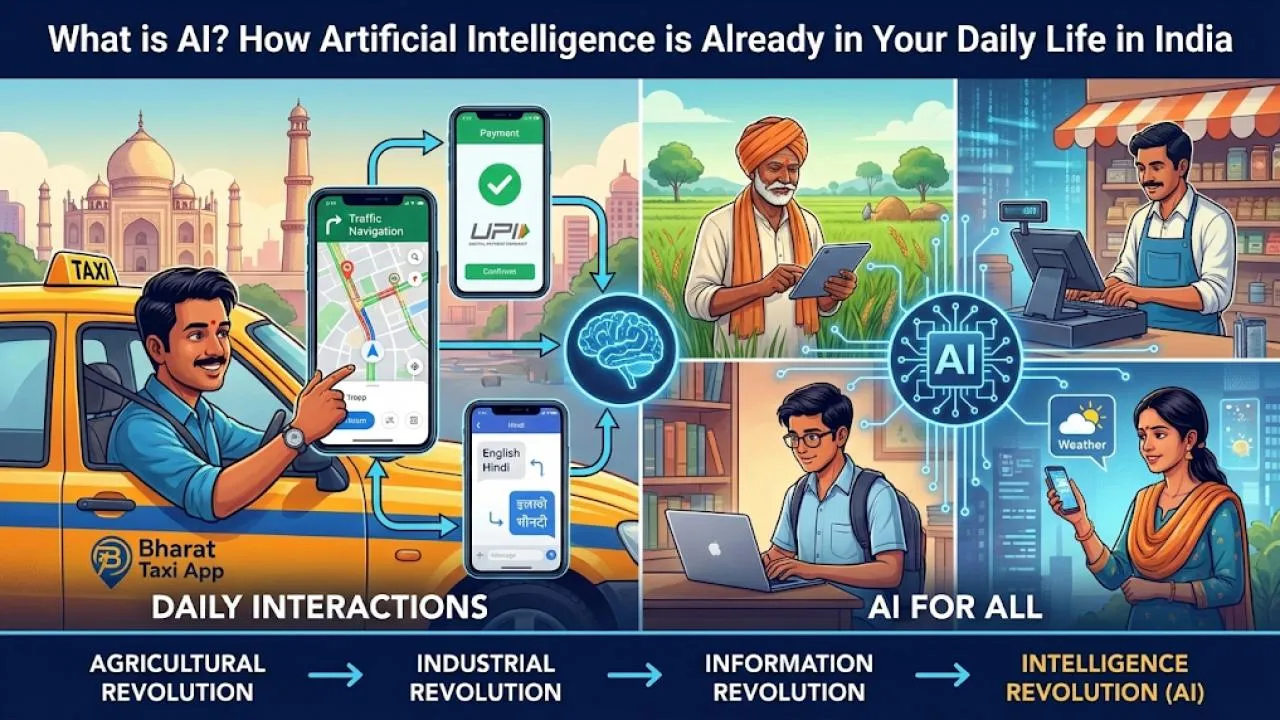
We all are in the world of advanced technologies today, and the latest and most powerful thing today is AI (Artificial Intelligence). Let's start a series today, Artificial Intelligence for All, where we can learn and understand artificial intelligence from the ground level up - and will majorly cover up the stuff for AI in the Indian market. You don't require coding or super tech skills to learn AI; all you need is just a smartphone or a laptop and an internet connection.
Let's talk about a simple scenario first: Shubham, a taxi driver, starts his daily work by getting a ride on the Bharat Taxi App, dropping them off at the location, and getting paid via common payment methods online.
How many times do you think Shubham uses AI? You are probably thinking he is just driving his car and dropping the passenger; why would he use AI? Let's dig deep and know how Shubham is using AI in his day-to-day life.
Here's what happens in Shubham's life in the background, which will make you realize that AI is not just sci-fi robots. AI is GPT (not the GPT of ChatGPT) but a general-purpose technology. It is like the internet or the electricity that is used to power everything, though we do not see it all the time. So, like electricity, AI is already helping millions of Indians like Shubham every single day.
Now let's see how many times Shubham used AI in this scenario:
Interaction 1:
Just after picking up his first passenger, Shubham checked the best route to the drop point on his smartphone using digital maps (Google Maps - AI Navigation).
Google Maps instantly analyzed thousands of data points, looked at live traffic from other phones, road closures, satellite feeds, and even the speed of other vehicles to find Shubham the fastest way to reach the drop point. That is AI in action.
Interaction 2:
When the passenger gets dropped off, they pay Shubham using UPI (unified payment interface) that we all use every day. The powerful AI system behind UPI analyzes the transaction in milliseconds and compares it to the millions of transactions to make sure it was legitimate and not fraudulent (AI Fraud Detection). This invisible shield protected both Shubham's hard-earned money and the passengers' account. This was Shubham's second interaction with AI, and he didn't even know it was happening.
Interaction 3:
Later in the day a foreigner shows Shubham an address on the paper written in English, but Shubham, who is naturally more comfortable reading in Hindi, simply points his phone's camera at the paper. Google Lens instantly translated the English text into Hindi (AI Translation) right there on the screen. This was Shubham's third interaction with AI before his day ended in the evening.
So how many times do you think Shubham uses AI? we can say Shubham uses AI 3 times all day, but the answer is not just 3; it's dozens of times, and the same is the case for you as well.
AI is no longer something from the future; it's already a part of our daily life. We are just like Shubham, and we don't realize how much it is helping us.
When you checked the weather, AI predicted whether it would rain today.
When you took a photo, AI automatically made it look better.
When opening the email inbox. AI helped filter all the spam messages out.
When buying products online on e-commerce sites. AI suggested products you might like.
AI is everywhere you go. So the question isn't "When will AI come to your place?" but rather "Are you ready to understand it and use it even better?"
So in the upcoming content of this series we will talk about all the AI stuff, which is happening right now.
We will talk about:
What is AI
How is it different from human intelligence
How AI literacy will give you an advantage in today's job market
In this content of this series, let's talk about What is Artificial Intelligence ?
To understand this, we need to start with humans and understand what we mean by intelligence. If we look back into our human history - we are very good at building tools and technologies that have made us number one species on the planet. Thousands of years back we have created tools and technologies that created agricultural revolution, when food become abundant. Many years on we created something called the industrial revolution where labour become free. A few revolutions further we invented tools and technologies that we call internet or search, which created the information revolution and then information became freely accessible and abundant. At the cusp of every such revolution, we are both excited and concerned because these revolutions doesn’t change how we work or how do we business, they change everything. How we live, our society, our workplace, our families, humanity, the planet, the environment, even which country is more powerful than other.
Now today in the new era of intelligence we are on the cusp of the next revolution where intelligence become free. It becomes freely accessible to everyone on tap and again as we stand right at the cusp of the intelligence revolution, driven by artificial intelligence, we are both excited as well as concerned.
But to understand what this AI revolution is, we need to understand how human intelligence works. It becomes much easier to understand how we have taught machines to be intelligent too. Take the example of the children learning to ride a bicycle. On the first day, they get on the bicycle and immediately fell down. They are scared, maybe cry a little. But what happens in their brain? They have learned something important “if I lean to much on either side I will fall”. On the second day they try again and this time they dont’ lean so much but lasted few more seconds before falling down again. Again their brain learns, keep the handle straight, don’t look down all the time. On another day they manage a few more seconds and day-by-day they get better. And after one week they cycle around confidently.
What happened here?
Child brain did three things:
It learned by understanding what worked and what didn’t.
Something good happened when it worked, and something not so good when it didn’t.
It adapted by changing their approach based on their learnings, finally improving.
This is intelligence - ability to learn from experiences and get better at solving problems
Whether you are learning to cycle, learning to cook, learning to read faces. Intelligence is always about learning from experiences and getting better.
Now, the way we think about intelligence is changing. For thousands of year if we wanted to solve a difficult problem, we only had few choices. You could be inherently smart or could get an expensive education or could hire an expert who could charge lot of money. Think about what happened with people with mobile phones! In that revolution, the phone revolution around 1995 only a rich people had mobile phones. Those devices were huge (like a brick block) which could only make calls that’s it. Today even a street vendor or Shubham a driver has his smartphone more powerful than the computers NASA had in 1990s. The same thing is happening with intelligence. Before, only big huge companies can analyze data. Only universities could do research. Only experts could solve complex problems. But now, a farmer in rural Himachal Pradesh can use AI to identify crop diseases or apply health. A small shop owner in Delhi can use AI to manage inventory. A student in Ludhiana can use AI to get personalised tutoring. This is because intelligence itself is becoming cheap and available to everyone. Just like mobile phones went from becoming luxury to necessity, AI is going from an expert tool to becoming an everyday helper. This is the biggest change in the internet history so far, because we are making intelligence free and widely available for everyone through this AI revolution.
Now we know what intelligence, now let’s define the simpler version of what AI (Artificial Intelligence) is:
Artificial Intelligence means teaching computers to learn and make decisions like humans do.
As we discussed the bicycle example above: A child learns by trying, making mistakes, and improving. AI does exactly the same thing, but with Data instead of physical practice. Just like a child learns by watching and trying. AI learns by studying millions and millions of example. Just like you can recognize your mothers voice among hundreds of voices, AI can recognises patterns in data. Just like you choose which route to take based on the traffic, AI makes decisions based on what it has learned and predicts. This magic ingredient in AI is called as Machine Learning. Its a fancy way of saying learning by studying lots of examples.
In simple definition Artificial Intelligence (AI) is teaching computers to learn patterns and make smart decisions, like humans do and Machine Learning is one way Al gets smarter by studying lots of examples.
Upcoming in this series we will learn more about Machine Learning and how it exactly works. Let’s keep unpacking what artificial intelligence really is. As it is a complex subject and you may encounter different definitions across the web about AI.
Experts from different fields define Al differently, because as a field AI covers lot many jobs, some people focus on the technical side: algorithms, data, and programming terms. But some people focus on the practical side: what AI can actually do for us. So here are some of the definition by different person:
John McCarthy
Defined Al as
The science of making machines do things that would require intelligence if done by people
Kaplan and Haeniein
Offered a more modern, computer science-oriented definition:
A system's ability to correctly interpret external data, to learn from such data, and to use those learnings to achieve specific goals and tasks through flexible adaptation
Codord English Dictionary
Provides a descriptive and precise definition:
The theory and development of computer systems able to perform tasks normally requiring human intelligence, such as visual perception, speech recognition, decision-making, and translation between languages
Encyclopaedia Britannica
The definition the authors prefer is:
Artificial intelligence (Al), the ability of a digital computer or computer-controlled robot to perform tasks commonly associated with intelligent beings
IGM
Started defining Al as augmented intelligence, believing that Al will 'augment human intelligence' rather than replace it
Alternative perspectives
Al has also been called assimilated (or collective) intelligence, as it gathers data from various sources to derive intelligence. Sometimes, it is referred as alternative intelligence, suggesting it is a different kind of intelligence compared to human Intelligence
Kate Crawford
In her book Atlas of Al, she famously states that Al is
Neither artificial (since it requires millions of human 'ghost workers' to make it work) nor intelligent (since it is just a pattern reading machine)
Some people worry about AI replacing humans, you would have heard of it or get worried about that but many others believe that AI will help humans become smarter than they are right now.
What you need to remember in the following series is that Al is simply computers learning to solve problems by studying examples, just like humans learn from experience.
Whether you call it Machine Learning, Artificial Intelligence, Smart Computers; basic idea is the same.
#ArtificialIntelligence #MachineLearning #AI #India #ML #computers #intelligence #learning #Artificial #GPT #ChatGPT #Gemini #SmartComputers #Internet #Augmented #Humans #IndiaAI #BharatTaxi #App #Google #Maps #Deepmind