Modern AI is not incredibly powerful, but it is also very accessible. In fact, it has now reached a point where everyone can easily access it on their mobile phones, but it wasn’t always this way. Just like a Bollywood movie, the AI story is full of dreams, failures, comebacks, and eventually, great success.
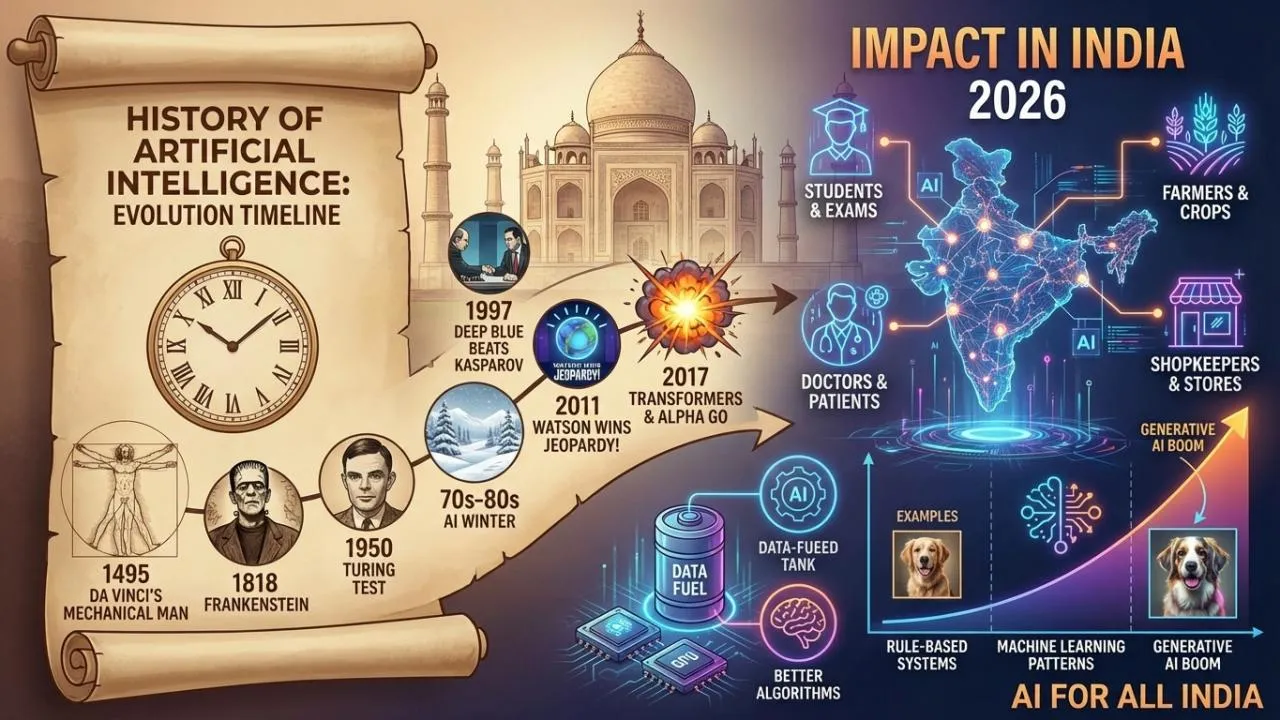
500 years ago, in 1495, Leonardo Da Vinci, the famous artist who painted the Mona Lisa, drew plans for a mechanical man. Even centuries ago humans were dreaming of creating artificial life. 200 years ago, in 1818, Mary Shelley wrote “Frankenstein,” a story about creating artificial life. People have always been fascinated by this idea. In 1950, Alan Turing asked a simple question: “Can machines think?” He created a test called the Turing Test that we still use today, which differentiates AI from non-AI. It was in 1956 that scientists at Dartmouth College officially invented the term “artificial intelligence.” They were very excited and predicted that AI would solve all the world’s problems within ten years. In 1865, Gordon Moore predicted that computers would become twice as powerful every two years, which is now called Moore’s Law. The 70s and 80s were what was called the ‘AI winter.’ Scientists had promised too much, AI couldn’t deliver, and people stopped believing in AI. Funding dried up, and progress slowed. In the 1990s, slowly AI started working on small problems. Computers began recognizing handwritten letters, for instance. In 1997, IBM’s Deep Blue computer beat the world chess champion, Garry Kasparov. People realized AI could be smarter than humans at specific tasks. In 2011, IBM’s Watson won a quiz show called ‘Jeopardy!’ It could now understand questions and answer them correctly, much like humans did. In 2017, Google DeepMind’s AlphaGo beat the world champion at Go, a game more complex than chess. And it’s then that the explosion happened. From 2017 everything changed; AI development went from slow progress to lightning speed. In 2017-2018, scientists invented new methods called ‘Transformers.’ The technology behind today’s ChatGPT. In 2019-2020, AI started writing human-like text and creating beautiful images. In 2021 AI became even better at understanding and creating content. 2022 was the breakthrough blockbuster year. OpenAI released ChatGPT on 30th November that year. Within five days, 1 million people were using it. Within two months, 100 million people. In 2023, every big tech company launched its AI assistant. Google made Bard (now Gemini); Microsoft integrated AI into Word and Excel. Meta released powerful AI models. In 2024, AI became mainstream. Millions of people today use AI for work, study, and creativity. In 2025-2026 we are now seeing AI everywhere, helping farmers, doctors, teachers, students, and business owners - everyone. In just eight years, AI went from research laboratories to your smartphone. That’s faster than any technology in human history. This timeline shows us that now is the perfect time to learn AI - how AI works and how we can use this wonderful technology to enhance our lives. Revolution is just beginning.
Let's move forward now with AI and understand the transformation from rule-based systems to generative AI with examples first:
For many people who know a little bit of programming or are into coding, you may understand that in traditional programming, upon describing something, computer output is based on the data it has been fed previously.
Eg:
If we input the computer with Type: Animal, Legs: 4, Color: Brown, and Barks: Yes. It would probably give you an answer “Dog” based on the inputs provided.
Moving ahead, predictive AI works a little differently, which we call "machine learned." In predictive AI we just import the image of the dog, and based on the past learnings, it will predict that it is a dog.
Generative AI, on the other hand, is very different. You just give the input to the computer to create an image of a dog, and it will be generating an image of the new dog for you based on your inputs.
Now let’s unpack this example.
AI’s journey can be divided into three eras, and each era has a completely different approach to making machines intelligent.
Rule-based system that ran from the 1950s to the early 2000s. Think of it as teaching a child to cook by giving them a recipe book of 10,000 recipes covering every possible situation. Much like that, scientist tried to write rules for everything (if this happens, do that; if that happens, do that)
This can be seen in the early computers, where computers were created specifically to beat humans in chess, like the one that beat Garry Kasparov. Humans programmed thousands of rules. This worked for simple, predictable, narrow situations. But real life is messy and complex. We can’t write rules for every single possible situation for everything.
Imagine teaching a computer to recognize a dog by just writing rules. You would need millions of rules and still wouldn’t cover everything.Here we go to the next era, where rule-based systems were replaced by pattern-learning ones. This happened from the 2000s to the 2010s. This is like teaching a child to recognize faces by showing thousands of photos, millions of photos. Not by describing what a face looks like. Smartphone face unlock works on the same basis as this. No one programmed it with rules about your face. Instead, it learned the rules by studying your face from many different angles. This approach powers most AI around us today.
For example, Instagram recommends the best reel to watch, or a phone gallery face recognition system, and even language translation apps. As we have discussed in the examples of dogs above, the machine learns the dog pattern by recognizing many dog photos labelled as "dog" and "not dog." Their computer learns by itself what makes a dog a dog by noticing patterns across millions of photos.And finally the third era, the current era of generative AI. Now AI doesn’t just recognize patterns; it creates new things using these patterns. It’s like a student who learned so much about poetry that they can now write original poems, or a computer that doesn’t just recognize dogs but creates new realistic pictures of dogs that we may have never seen before.
Each era is built on the previous one. Today’s generative AI combines all three approaches to create incredibly powerful and useful systems.
Now you might be wondering if humans have been working on AI since 1956, then why did it suddenly become powerful only in the last few years?
The answer to this question is the combination of three factors.
The availability of huge amounts of Data - The internet, social media, smartphones, have created an ocean of data (text, images, videos) This data is fuel to modern AI.
AI needs to see millions of examples to learn properly. It needs to have studied millions of dogs to understand what a dog is. Before smartphones and the internet, all this data didn’t exist. Think about our life: every photo we take, every message we send, and every payment we make creates data. India alone creates billions of data points every single day. This data is like textbooks for AI. The more the textbooks, the smarter the AI becomes.How powerful the computers are now - Graphics Processing Units (GPUs), once just for gaming, became perfect for the parallel calculations needed to train AI. They became cheaper and more powerful.
Training AI requires enormous computing power; for decades it was too expensive or sometimes too slow. The breakthrough came from video games; the powerful chips made for gaming turned out to be perfect for AI training. We now had tools to train massive AI systems.
So if a human being can read 10,000 books over a lifetime, then a powerful AI can read 25 million of them.The last factor is that we have better learning algorithms - Scientists discovered smarter, more efficient methods (like deep learning and transformers) for computers to learn from all that data.
Having data and computers wasn’t enough; we needed better ways to teach AI. As in 2017, scientists then invented Transformers. A new method or a new kind of AI to understand language. This is the breakthrough that made ChatGPT possible.
This is why AI exploded in the last few years: all three things happening at once and all the pieces of the puzzle coming all together at the same time.
Now you understand what AI is and how it is developed. The interesting part is AI is not only helping Silicon Valley or Bengaluru or Gurugram tech giants. It is helping ordinary Indians in extraordinary ways.
Students studying for exams.
Farmers growing crops.
Doctors treating patients.
Shopkeepers managing stores.
AI is transforming lives across India.
AI is not the future; it is happening now today in every city and every state of our country.
Save this series as your favorite and wait for the upcoming topics on AI in India.
Read the previous content of the series here: What is AI? How Artificial Intelligence is Already in Your Daily Life in India
Save the series: Artificial Intelligence for All.
#ArtificialIntelligence #MachineLearning #AI #India #ML #computers #intelligence #learning #Artificial #GPT #ChatGPT #Gemini #SmartComputers #Internet #Augmented #Humans #IndiaAI #BharatTaxi #App #Google #Maps #Deepmind #Transformers